|
 |

|

|

|
-

Cochin(Kochi),Kerala Cherai,Kerala Athirapally,Kerala Munnar,Kerala Marayoor,Kerala Thekkady(periyar),Kerala Vagamon,Kerala Kumarakom,Kerala Alappuzha,Kerala Thiruvantahpuram,Kerala Kovalam,Kerala Guruvayoor,Kerala Wayanad,Kerala Bekkal,Kerala Nilambur,Kerala
|
|

|

|

|
 |

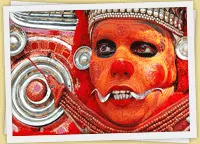 |
Kerala has a rich history of art and culture. Preservation of our rich heritage is possible only through the popularization of ancient art forms, which are deeply rooted in our culture. Our aim is to showcase the kerala painting, dance, music, handicrafts, jewellery and all kerala art forms and thus to create an awareness worldwide about our glorious cultural heritage. |
Kathakali :
Kathakali is said to be the greatest and complex of all art forms. It is said to have evolved from other performing arts like Kootiyattam, Krishnanattam and Kalarippayattu. Kerala owes its transnational fame to this nearly 300 years old classical dance form which combines facets of ballet, opera, masque and the pantomime. Kathakali explicates ideas and stories from the Indian epics and Puranas.
Mohiniyattom :
Mohiniyattom, said to be poetry in motion, is the classical dance form of Kerala with slow, graceful, swaying movements of the body and limbs and highly emotive eye and hand gestures. It is the sinuous dance of the enchantress. Mohiniyattom was performed by the Devadasis or temple dancers, hence also the name 'Dasiattam' which was very popular during the Chera reign from 9th to 12th century.
Koothu :
Koothu is a solo narrative performance interspersed with mime and comic interludes. It is a socio-religious art performed in the Koothambalam or the Koothuthara of temples, either independently or as part of Kootiyattam. Through the inimitable narration of stories from the epics (The Ramayana and The Mahabharatha), the Chakkiar satirises the manners and customs of the time. His wit ranges from innocent mockery to veiled innuendoes, barbed pun and pungent invectives. Koothu is intermittently accompanied by the percussion instrument Mizhavu. Nangyar Koothu is a variation of the Koothu performed by the Nangiars or the female members of the Chakkiar community. This is a solo dance drama mainly centred on the legends of Sree Krishna.
Margomkali :
The Syrian Christians of Kerala usually perform Margomkali. A dozen dancers sing and dance around a lighted lamp (Nilavilakku) in the simple traditional white dhoti. The narration is stark without musical accompaniments. The songs date back to a period much before the Portuguese invasion. Nowadays, women perform Margomkali only as a stage item.
Chavittunatakom :
Chavittunadakam is a Christian art form of Kerala evolved at the turn of the 16th Century AD during the Portuguese colonization and bears definite traces of the European Christian Miracle Play. It is a musical drama in which the actors wear Greco-Roman costumes and even the stage props bear several foreign influences. In the past, the Chavittunatakom was performed on open stages, though sometimes the interior of a church was also a venue. The language is a colloquial mix of Tamil and Malayalam.
|
|
|
|
|

|
 |
|
Cherai Beach Tour,Kerala
|
Kerala Treehouse package,Kerala
|
Backwater Ripples,Kerala
|
Parambikulam Tour Package,Kerala
|
|
Kerala Houseboat Package,Kerala
|
Munnar hillstation with houseboat journey,Kerala
|
Munnar Tour Packages,Kerala
|
Wayanad Tour Package,Kerala
|
|
kerala weekend tour packages,Kerala
|
Kerala Wildlife Tour,Kerala
|
theyyam tour packages kannur,Kerala
|
Kerala Hillstation and wildlife tour,Kerala
|
|
Kerala Wildlife and Backwater Tour,Kerala
|
Kerala tour packages 3 nights 4 days,Kerala
|
Exotic Kerala ,Kerala
|
munnar tour packages from chennai,Kerala
|
|
Melody of Kerala,Kerala
|
Kerala Beach and backwater tour,Kerala
|
Splendid Kerala Tour,Kerala
|
Athirapilly waterfalls tour with munnar and houseboat,Kerala
|
|
Kerala tour packages from bangalore,Kerala
|
South India Temple Tour,Kerala
|
kerala honeymoon packages with private pool,Kerala
|
Poovar Island Tour Package,Kerala
|
|
Wayanad Coorg Tour Packaes,Kerala
|
Hills n Lakes,Kerala
|
kerala budget tour , cheapest kerala tour,Kerala
|
Orange Dumbling,Kerala
|
|
kerala tour packages with taj hotels,Kerala
|
Colors of Kerala,Kerala
|
Bangalore Mysore Ooty tour package,Kerala
|
Kerala tour packages with flight,Kerala
|
|
Kerala Family Tour Package,Kerala
|
Kerala tour package with price,Kerala
|
CGH Earth Experience Tour,Kerala
|
Cochin Munnar Thekkady Kumarakom Alleppey Houseboat,Kerala
|
|
South Indian Panoramic, Bangalore - Mysore - Ooty- Wayanad - Calicut,Kerala
|
Athirapilly waterfalls , Munnar , Alleppey houseboat , Kovalam tour package,Kerala
|
Kerala Wonders,Kerala
|
Kerala Tour Package with Kanyakumari,Kerala
|
|
Kerala Homestay Tour Packages,Kerala
|
The Southern magic,Kerala
|
Beautiful Kerala,Kerala
|
Legendary South India Tour ,Kerala
|
|
Tamilnadu and Kerala Tour Package,Kerala
|
 |
|
|
|
|
|